
How To Find a Graphic Designer Who Works With Startup Companies and Small Businesses
Starting a new company is exhilarating, but it can also be incredibly overwhelming—especially when it comes to creating your logo and brand identity. There’s a lot of pressure to have a business card, a slick website, and a polished social media presence right out of the gate.
But with so many other startup expenses—equipment, hiring, uniforms, signage, packaging—the idea of working with a professional graphic designer can seem like a daunting task. Many founders don't know where to begin, which leads them to make short-sighted decisions that cost them dearly down the road.
If you are a founder looking for a graphic designer, here is how you should approach the process, depending on exactly where you are in your startup journey.
The "Side Hustle" Phase: When Not to Hire a Designer
If you find yourself in the position of having little to no budget for a logo, my biggest recommendation is going to sound counterintuitive: Don't hire a designer yet.
Often, early-stage founders make the mistake of hiring an inexpensive designer who never takes the time to get to know them and is unable to articulate their brand story.
Instead, just type the name of your business in a clean font that seems to fit the vibe of your company and use that for now. Over the first few years of running your business—whether you are selling at the local farmer's market or running it as a side hustle—you will discover what actually makes your company unique. It takes time to understand what truly resonates with your clientele and what sets your product apart from the rest. Those pieces of information are absolutely crucial to creating a strong brand identity later on.
The "All-In" Phase: Ready to Make a Statement
I often get contacted by business owners who started with a temporary logo to get by, but are now in a place where they can leave their day jobs, open a commercial space, and go all-in.
This is the perfect time to hire a professional designer.
By this point, you know what sets you apart. You can easily identify your target audience. Just as importantly, you know what you don't want to do with your business—something you probably didn't know on day one. You have refined your best practices and you are ready to make a serious statement.
Now, you need a professional who can help you craft a complete identity system—packaging, colors, fonts, and assets—that clearly presents your brand to the world.
Red Flags and Green Flags: Who to Hire
When you are ready to make that investment, you have to be careful about who you partner with. Here is what to look for—and what to avoid:
Green Flag: Deep Collaboration. Only work with a designer who wants to get to know you very, very well. The process should be highly collaborative, with plenty of back-and-forth regarding aesthetics, tone, and feel.
Green Flag: A Focus on Story. Your brand identity is the visual expression of your unique story. If a designer isn't interested in helping you craft and communicate that story, they cannot create a truly memorable brand.
Red Flag: The "Spaghetti on the Wall" Approach. Never work with a designer who just creates a bunch of random logos and throws them at the wall to see what sticks.
Red Flag: No Face-to-Face Contact. Avoid working with anyone you cannot meet with, whether in person or via video chat. Avoid platforms like Fiverr where communication is restricted to email; those designers will likely never understand your brand culture or your local competition.
Red Flag: White Labeling. Never work with an agency that plans to outsource your logo overseas. "White labeling" is common right now—you hire an agency, but they subcontract the work. Always ask if the people you are meeting with are the actual designers who will be working on your project.
Seeing It In Action: Hellbranch Cider Company
To see the difference this collaborative approach makes, look at Hellbranch Cider Company.
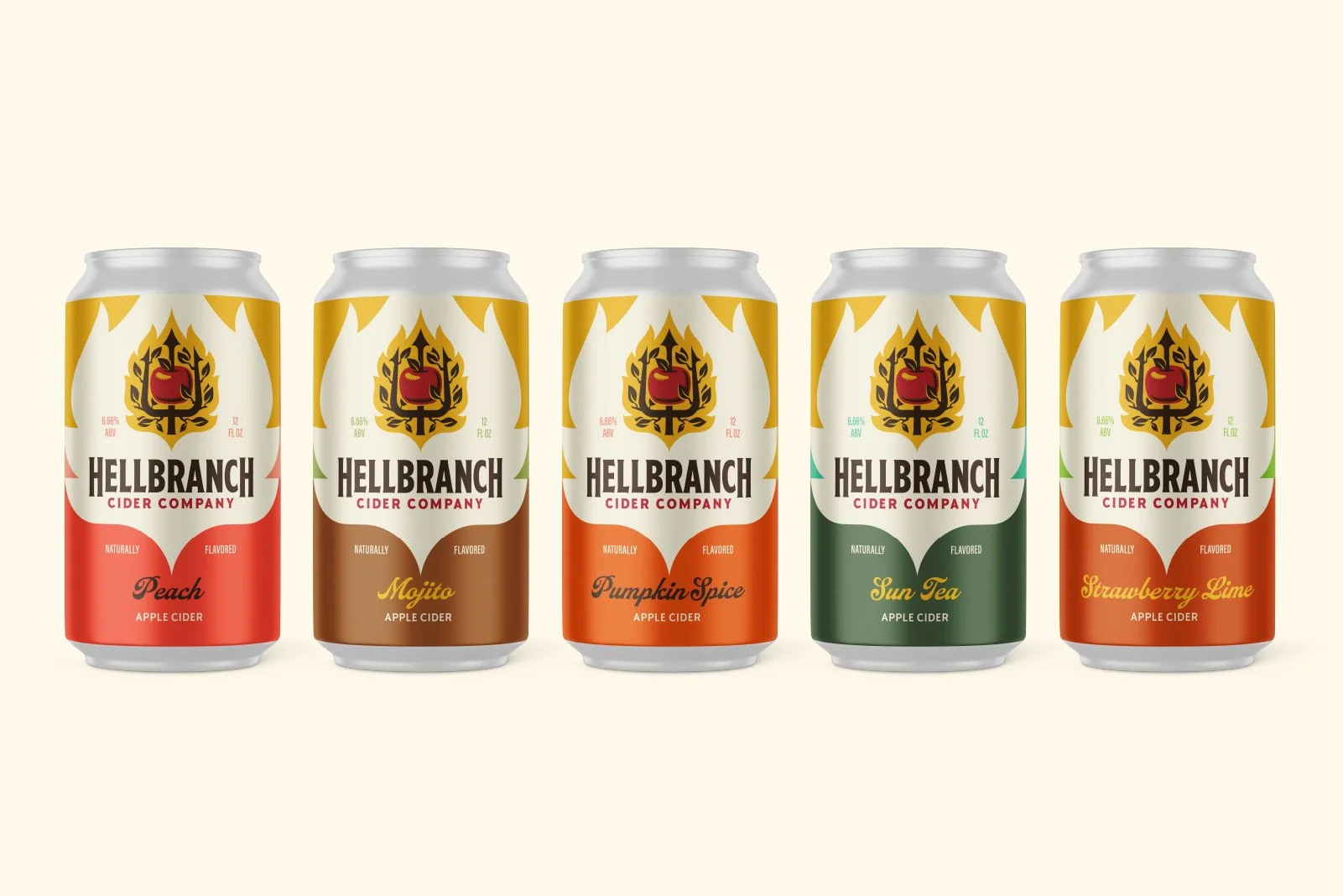
What started as a hobby for founder James Wilson eventually turned into a full-time business. He started out with an original logo that was very difficult to reproduce at small sizes and simply did not stand out on the shelf. With a name like "Hellbranch," there were so many missed opportunities to tell a cool story with unique visuals.
We didn't just throw away his history; we started where the original logo was. Through the process of in-person meetings at his business and field trips to local markets, we identified the most important aspects of their brand. The result was a new logo and identity system that is impactful, flexible, easy to implement, and speaks clearly in their brand voice. Today, Hellbranch has a memorable mark and packaging that jumps off the shelves.
The Real Cost of a Logo (and Why It Matters)
Figuring out how much a logo should cost is incredibly confusing for startups. You will find logos starting at $50 and ranging all the up to $100,000, coming from various levels of expertise and agency sizes.
Here is the truth: The cheap logo is often the most expensive one.
When you consider how much you are going to spend implementing that identity—printing packaging, buying uniforms, fabricating exterior and interior signage—it is vital to get it right the first time. If you buy a cheap logo now and have to redo it a few years down the road, you have to pay to reprint and recreate everything.
My best advice for a startup budget? Look for someone with lots of experience who is running a studio with low overhead. A boutique agency can often offer the exact same expertise as a large agency, but at a fraction of the cost. Finding a world-class logo in the $10,000 to $20,000 range is very achievable—often from the exact same designer who would be doing the work if you paid a massive agency $100,000.
When you invest in a professional, collaborative process, the results from your brand identity will pay for themselves many times over.